
Hard Water in the San Gabriel Valley, What It's Doing to Your Pipes & Whether You Need Filtration
The SGV has some of the hardest tap water in Southern California. Here’s the honest breakdown of what 300+ ppm is doing to your appliances, your copper pipes, and your skin, and whether a $2,500 whole-house softener pays for itself in a Pasadena, Arcadia, or Alhambra home.
The 30-second briefing on SGV hard water
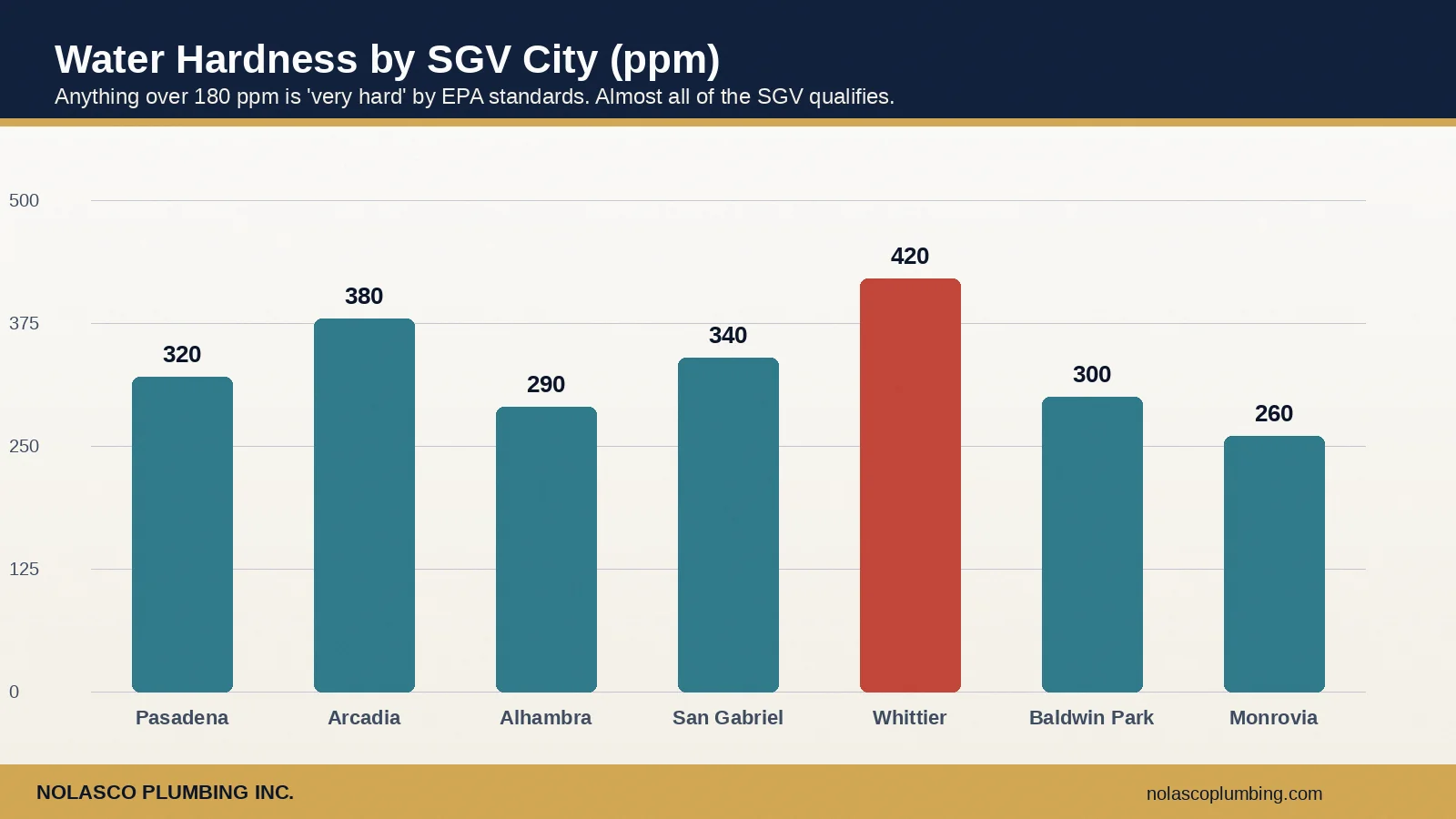
- Hardness by city: Whittier 420 ppm, Arcadia 380, San Gabriel 340, Pasadena 320, Baldwin Park 300, Alhambra 290, Monrovia 260. EPA "very hard" starts at 180 ppm.
- What it costs you: Water heaters die 30–40% sooner, dishwashers/washers lose 3–5 years of life, and pinhole leaks in copper accelerate.
- Filtration options: Salt softener ($1,800–$3,500), salt-free conditioner ($1,400–$2,800), or point-of-use RO ($500–$1,400).
- Payback: A $2,500 softener typically pays for itself in 4–7 years through extended appliance life + reduced detergent use.
How hard is SGV water, really?
The San Gabriel Valley averages 250–420 ppm (parts per million) of calcium and magnesium, well above the EPA’s 180 ppm threshold for “very hard” water. Water sourced from the SGV’s underground aquifer picks up minerals as it flows through the alluvial soil left by the San Gabriel Mountains, and by the time it reaches your tap it’s some of the mineral-richest water in Southern California.
To put those numbers in context: Los Angeles Department of Water & Power (which serves parts of Alhambra and Sun Valley) averages 150 ppm. Long Beach averages 175 ppm. San Francisco averages 30 ppm. The SGV isn’t just hard, it’s a national outlier.
The exact number depends on which utility serves you. Pasadena Water & Power, Golden State Water, Suburban Water Systems, and the various city-owned utilities all pull from slightly different well fields with slightly different mineral concentrations. Call your utility or check their annual Consumer Confidence Report for your specific address if you want the precise number.
What hard water is actually doing to your home
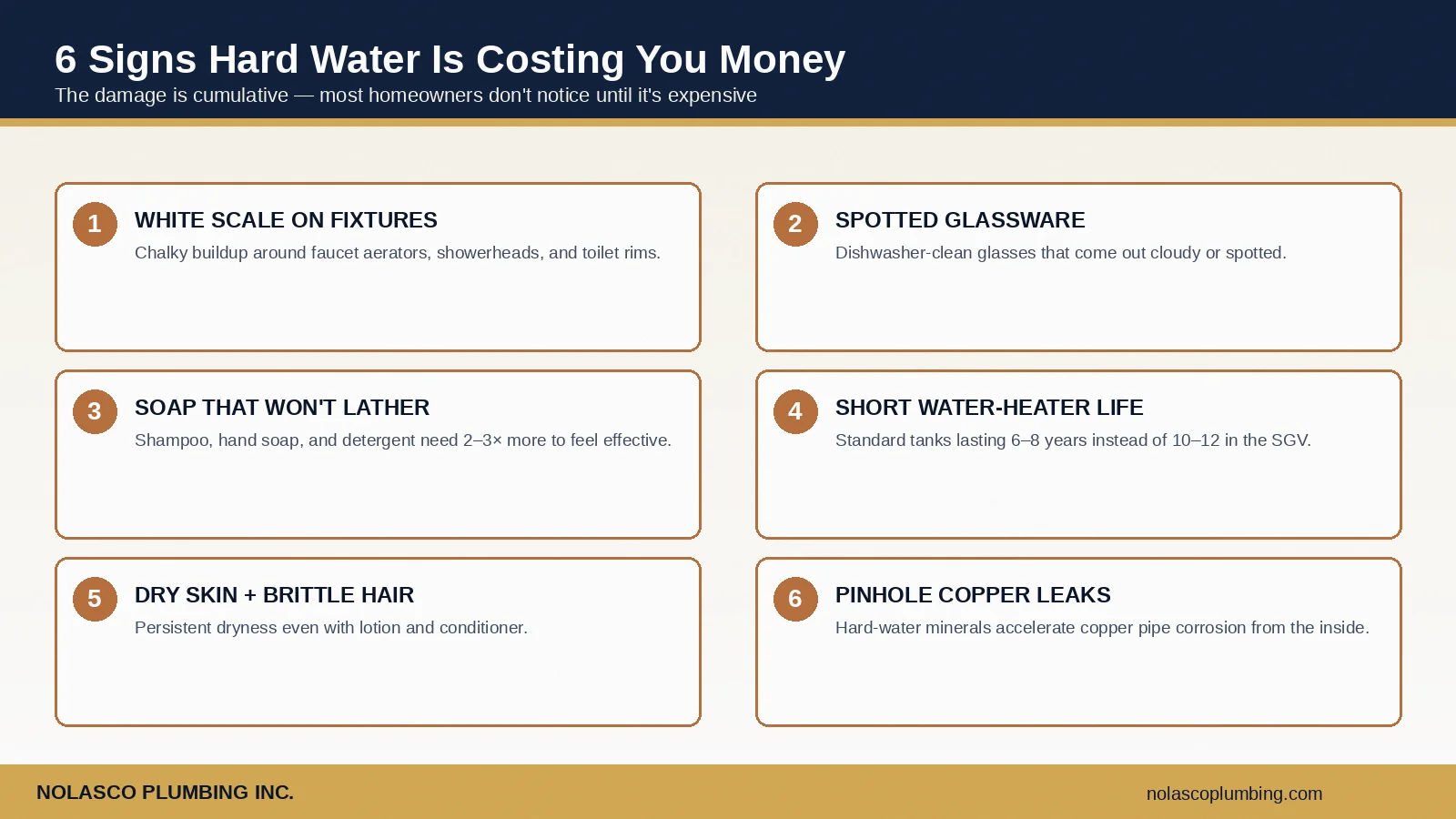
Hard water damage is cumulative and mostly invisible until it’s expensive. The four biggest financial hits are: (1) shortened water heater life, SGV tanks often die at 6–8 years instead of 10–12, (2) failed dishwashers and washing machines at 7–9 years instead of 12–15, (3) pinhole leaks in copper supply lines that cause slab leaks, and (4) 30% more soap, shampoo, and detergent to get the same clean.
Water heaters are the biggest single victim
Every gallon of hot water passing through a tank leaves a tiny mineral deposit on the heating element or gas burner surface. Over years, that scale builds into a thick insulating layer that forces the heater to run 20–30% longer to hit temperature, which prematurely fatigues the tank lining. That’s why a standard tank in Pasadena or Arcadia often fails at year 8 instead of year 12.
Appliances lose 30–40% of their expected life
Dishwashers, washing machines, refrigerator ice makers, coffee makers, all of them scale up. The visible chalky ring around your washer’s rubber gasket is just the tip of it. Internal solenoid valves, spray arms, and heating elements all get insulated by mineral deposits, which is why appliance repair calls in the SGV run higher than the national average.
Copper pipes corrode from the inside
Skin, hair, and every fabric in your house
Soap and shampoo bind to calcium instead of dissolving properly. That means the soap film stays on your skin (dryness, itching) and in your laundry (dingy whites, scratchy towels). The single most-mentioned lifestyle improvement in our post-softener install surveys is “my skin doesn’t feel tight after showers anymore.”
Filtration options, the three that actually work in the SGV
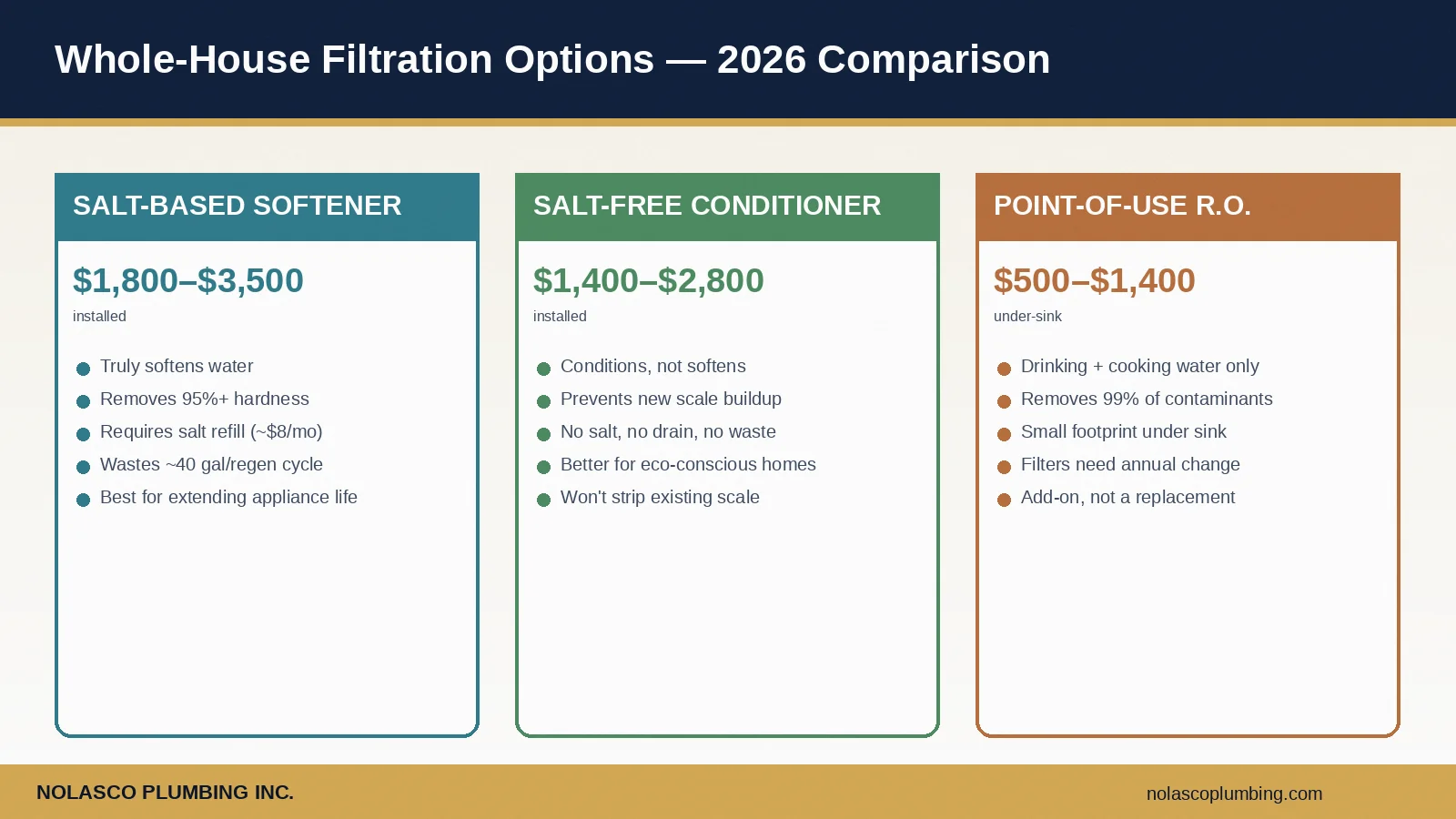
SGV homeowners have three legitimate whole-house / point-of-use options: a salt-based softener (best for actually removing hardness, $1,800–$3,500 installed), a salt-free conditioner (best for preventing new scale without maintenance, $1,400–$2,800 installed), or a point-of-use reverse osmosis under the kitchen sink for drinking water only ($500–$1,400 installed).
Salt-based softener is best if…
You want to truly soften the water (measurably), extend the life of your water heater and appliances, and you have space for the tank + brine tank in your garage. Expect to add ~$8/month in salt and one bag every 4–6 weeks.
Salt-free conditioner is best if…
You care about environmental impact (no salt discharge to sewer), you’re on a water district with brine restrictions, or you don’t want the maintenance. It prevents new scale from adhering to surfaces but doesn’t reduce the ppm measurement.
RO under the sink is best if…
You’re renting or don’t want a whole-house system yet, but you want great drinking water. Removes 99% of contaminants at the kitchen tap. Doesn’t help your water heater, appliances, or skin.
| System | Installed Cost (SGV, 2026) | Maintenance | What It Fixes |
|---|---|---|---|
| Salt-Based Softener | $1,800–$3,500 | Salt refill (~$8/mo) | Everything, appliances, skin, pipes |
| Salt-Free Conditioner | $1,400–$2,800 | Media swap every 5–7 yrs | New scale, appliance life |
| Point-of-Use R.O. | $500–$1,400 | Filters annually ($60/yr) | Drinking water only |
| Softener + R.O. Combo | $2,300–$4,500 | Both above | Best-in-class household solution |
Does a whole-house softener actually pay for itself?
In most SGV homes: yes, in about 4–7 years. A $2,500 softener extends the life of your water heater by 3–4 years ($1,200 saved), your dishwasher by 3–5 years ($400 saved), your washing machine by 3–5 years ($400 saved), and cuts detergent/soap costs by ~30% ($150/year). Add the prevention value on future slab leaks and the math clearly favors installation for anyone staying in the home 5+ years.
The math weakens if you’re renting the softener (monthly service contracts eat the savings) or if you’re planning to sell within 3 years. It gets stronger the older your home is, a 40-year-old Craftsman in Pasadena with copper in the slab benefits more than a 2015 build in Baldwin Park.
What SGV homeowners get wrong about hard water
1. Buying a cheap Costco/Amazon unit
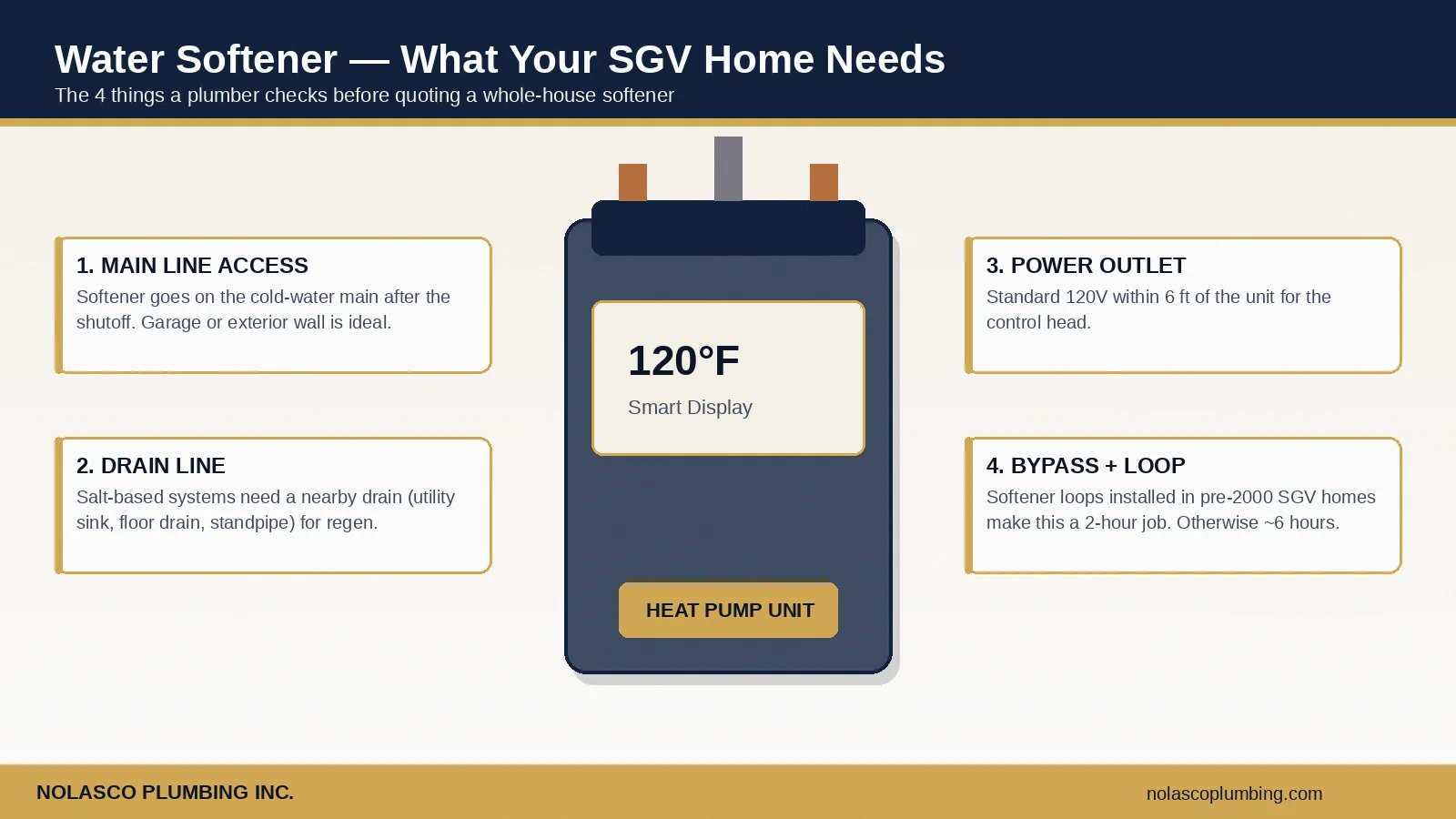
The head unit is where 80% of the reliability lives. A $600 no-name softener will out-fail a $2,000 Kinetico or Rainsoft within 3 years. Buy the head, not the tank.
2. Skipping the drain line
Salt-based softeners regenerate by flushing brine to a drain. If your utility area doesn’t have a nearby drain, retrofitting one adds $300–$700 to the install. Check before you order.
3. Installing without a bypass loop
You want to be able to bypass the softener for outdoor irrigation (plants prefer minerals) and during maintenance. Homes built after 2000 in the SGV usually have a pre-plumbed softener loop. Pre-2000 homes usually don’t, factor that in.
4. Ignoring the drinking-water side
Softeners add a small amount of sodium to your water. If someone in the household is on a low-sodium diet, pair the softener with an under-sink RO for the kitchen faucet. Combined install costs $2,300–$4,500 and is the setup we most often recommend.
Wondering if a softener is worth it for your house?
We’ll test your actual water at the tap (free), measure your utility space, and give you an itemized quote for a softener, a salt-free conditioner, and RO, with straight talk on which one fits your home. Financing available through Wisetack.
Frequently Asked Questions
How hard is the water in the San Gabriel Valley?
Very hard by EPA standards. Water hardness in the SGV ranges from about 260 ppm in Monrovia and Sierra Madre to 380–420 ppm in Arcadia and Whittier. Pasadena averages around 320 ppm, San Gabriel around 340 ppm, and Alhambra around 290 ppm. Anything over 180 ppm is officially “very hard.”
Do I really need a water softener in the SGV?
If you own the home and plan to stay 5+ years, yes, probably. The math typically pencils out: a $2,500 softener extends the life of your water heater, dishwasher, washing machine, and copper pipes by 30–50%, saves 30% on soap and detergent, and can prevent the pinhole leaks that cause slab leaks in older SGV homes.
What's the difference between a water softener and a salt-free conditioner?
A traditional salt-based softener uses ion exchange to actually remove calcium and magnesium, it makes water “soft.” A salt-free conditioner alters the mineral structure so it doesn’t stick to surfaces, but the minerals stay in the water. Softeners are more effective; conditioners are lower-maintenance and better for the environment.
How much does a whole-house water softener cost in the SGV?
In 2026, a good salt-based whole-house softener installed by a licensed plumber runs $1,800–$3,500. A salt-free conditioner runs $1,400–$2,800. Under-sink RO for drinking water only runs $500–$1,400. Costs go up if a bypass loop or drain line needs to be added.
Does hard water cause pinhole leaks in copper pipes?
Yes, it’s one of the main causes of slab leaks in older SGV homes. Hard water minerals scour the inside of copper pipes, and the resulting corrosion creates pinhole leaks that grow over years. This is especially bad in pre-1990 homes where copper was poured directly into the slab.
Will a water softener help my skin and hair?
Yes, noticeably. Most SGV homeowners report their skin stops feeling tight after showers within a week of softener installation, and shampoo lathers with roughly half as much product. It’s the single most-mentioned lifestyle improvement in our post-install surveys.
Service Areas Across the San Gabriel Valley
Altadena · Arcadia · Azusa · Baldwin Park · Covina · Duarte · El Monte · Glendora · Hacienda Heights · Irwindale · La Cañada Flintridge · La Puente · La Verne · Monrovia · Monterey Park · Pasadena · Pomona · Rosemead · Rowland Heights · San Dimas · San Gabriel · San Marino · Sierra Madre · South El Monte · South Pasadena · Temple City · Walnut · West Covina.