
Plumbing Emergency in the SGV, Room-by-Room Shut-Off & What to Do Before the Plumber Arrives
The next 10 minutes decide whether this is a $400 fix or a $14,000 insurance claim. Here’s where every shut-off valve is in a typical Pasadena, Arcadia, Alhambra, or Baldwin Park home, and the 5-step protocol that saves your floors and walls.
Do these 5 things in this order
- 1. Shut off the main water valve, usually on an exterior wall or in the garage. Turn CLOCKWISE.
- 2. Cut power to affected areas at the breaker if water is near outlets or fixtures.
- 3. Photograph everything for insurance BEFORE moving anything.
- 4. Call 626-667-2007, Nolasco 24/7 emergency line.
- 5. Move valuables + soak up water while you wait. Do NOT attempt DIY repair.
Step 1: Find and close your main water shut-off, right now
The most important skill in a plumbing emergency is knowing where your main water shut-off valve is before you need it. In a typical San Gabriel Valley home, it’s in one of four places: (1) on an exterior wall where the water line enters the house, (2) in the garage along the shared wall, (3) in a utility closet, or (4) if you can’t find any of those, the street meter shut-off in the sidewalk box out front, which requires a 5-sided meter key you can buy at any hardware store for $12.
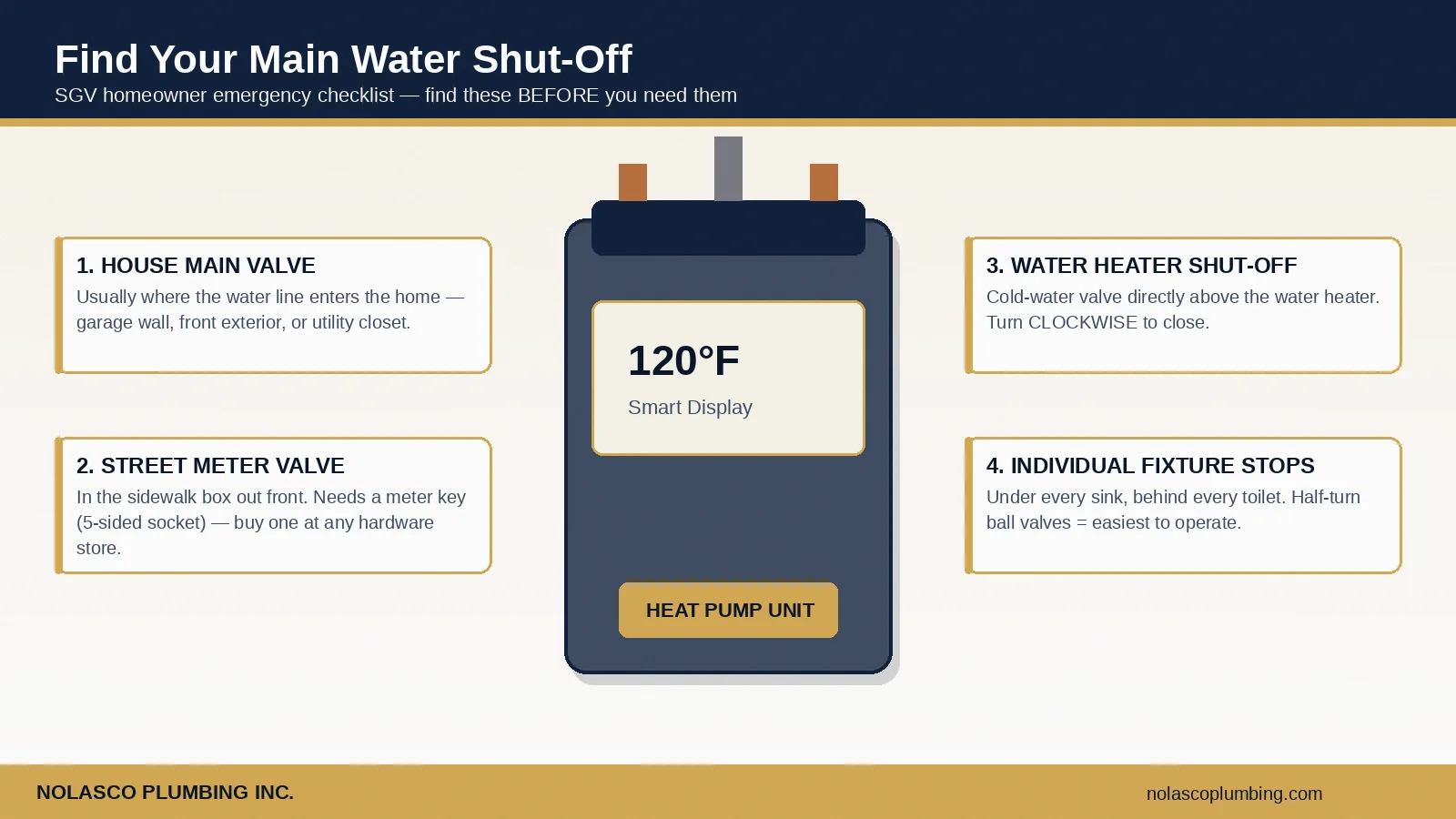
Every valve turns clockwise (right) to close. If your main valve is a gate valve (round handle) and hasn’t been turned in 10+ years, it may be stuck. Don’t force it with a wrench, a broken gate valve turns an emergency into a bigger emergency. If it won’t turn by hand, go to the street meter.
The street meter valve is your final fallback. It lives in a rectangular concrete or plastic box in the sidewalk in front of your house, usually about 6 inches below grade. Lift the lid, look for the valve with the 5-sided pentagon nut, and turn it with a meter key. Every SGV homeowner should own a meter key, it’s the cheapest disaster-prevention tool you can buy.
Room-by-room shut-off guide
Every room in a typical SGV home has one or more local shut-off valves that let you stop water to that fixture without cutting off the whole house. These are the quarter-turn ball valves under sinks and behind toilets, and the hose bib valves behind washing machines. Knowing where each one is means you can isolate a leak in seconds without turning off water for the whole house.
Kitchen
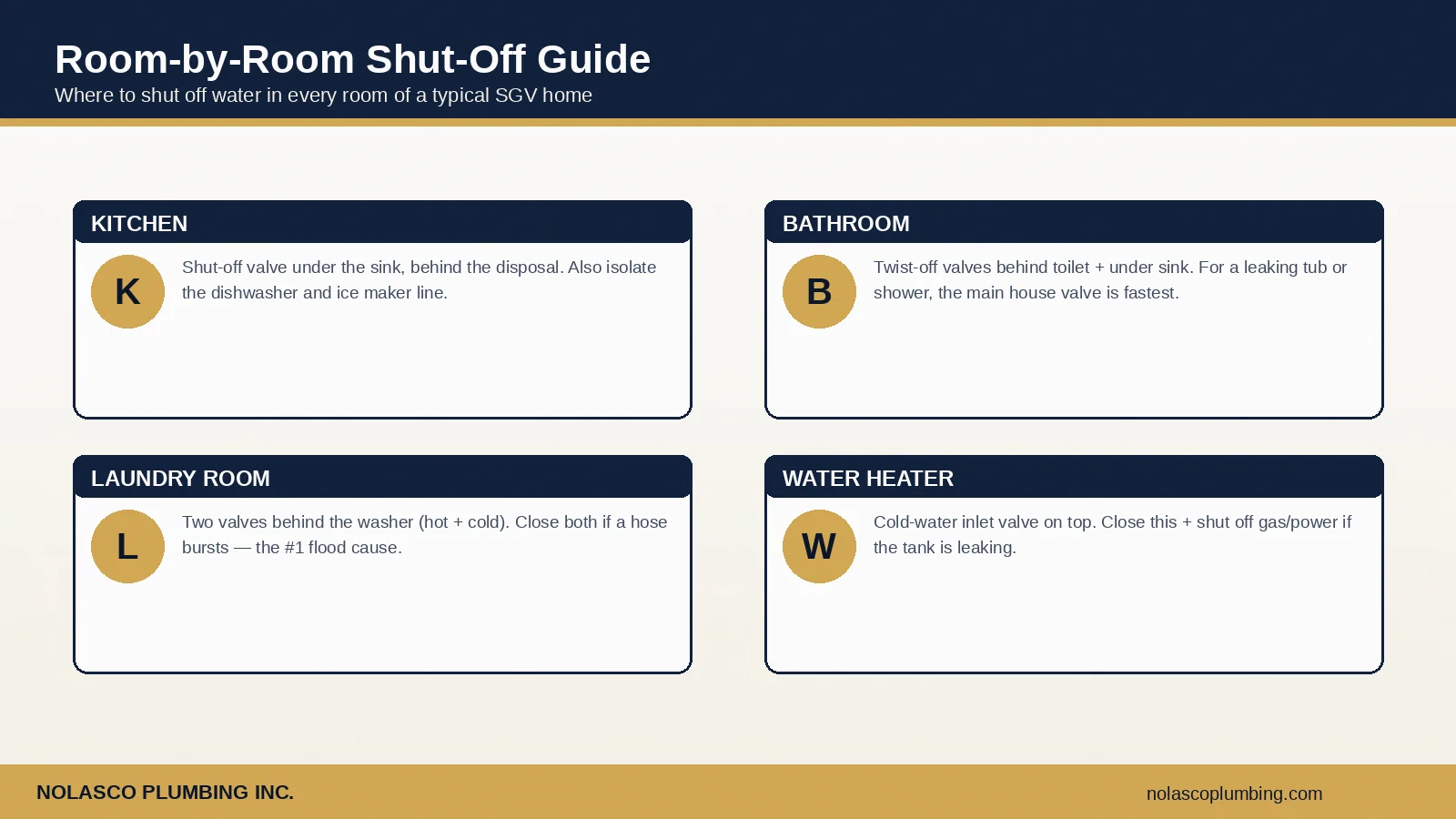
Shut-off valves for hot and cold are located under the sink, on the wall behind the disposal. There are usually 2–4 valves total (sink, dishwasher, sometimes refrigerator ice-maker, sometimes filtered water). Turn each one clockwise. If the kitchen sink is spraying, shut the valve directly under the fixture, don’t shut the main.
Bathroom
Every toilet has a shut-off valve on the wall behind the tank, usually on the left. Turn clockwise to stop water to a running or overflowing toilet. Sinks have shut-off valves in the vanity cabinet. For a leaking tub or shower, there’s no local shut-off, go straight to the main house valve.
Laundry Room
Water Heater
The cold-water inlet valve is on top of the tank (or on the wall directly above a tankless unit). If the tank is leaking, close this valve, then shut off gas (yellow tag valve on the gas line) or electricity (breaker) to the unit. Don’t try to drain the tank, that’s a plumber’s job during replacement.
The 5-step emergency protocol
This is the sequence to follow the moment you discover water where it shouldn’t be. Skipping steps costs money.
- Shut off water at the closest valve. Local shut-off if the source is a toilet, sink, or washer. Main house valve if it's a burst pipe, shower, or you can't isolate the source in under 60 seconds.
- Cut power to affected areas. If water has reached outlets, light fixtures, or a panel, kill those circuits at the breaker box. Do not touch anything electrical while standing in water. If water has reached the main panel itself, kill the main breaker or call your utility.
- Photograph and video everything. BEFORE moving anything, get clear photos and video of the source of the leak and every affected surface. Wide shots for context, close-ups for detail. Insurance carriers require visual evidence and will short-pay claims without it.
- Call a licensed 24/7 plumber. Nolasco Plumbing at 626-667-2007 answers 24/7 across the SGV. Have your address, the main valve status ("water is off"), and a one-sentence description of the source ready.
- Move valuables and start cleanup. Lift furniture legs onto blocks or foil. Move electronics, rugs, and paper to a dry area. Use towels or a wet-dry vacuum to slow the spread. Do not try to repair the pipe yourself.
What NOT to do, the mistakes that turn $400 fixes into $14,000 claims
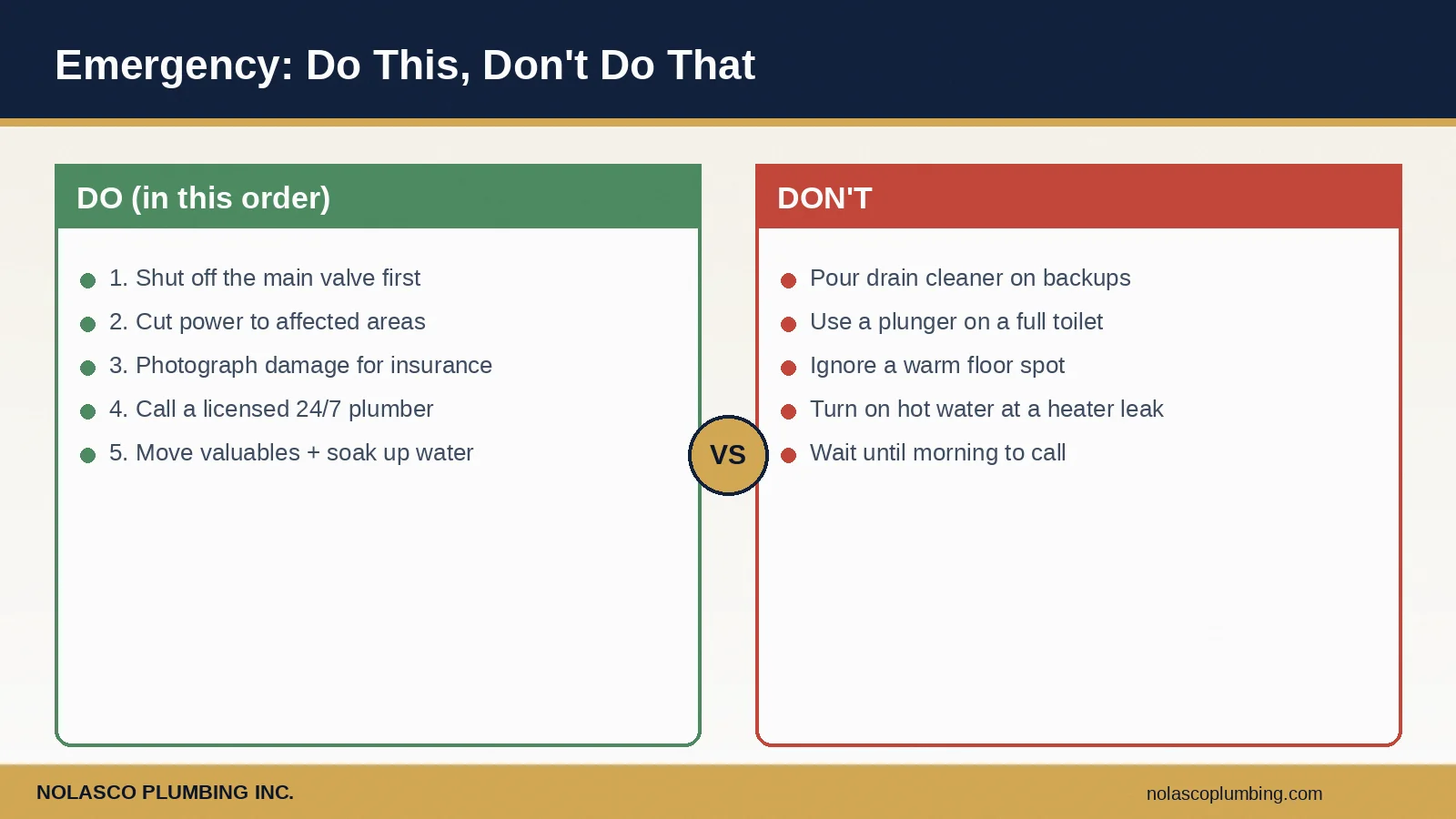
Don’t pour drain cleaner on a backup. If a toilet or drain is backing up sewer water, chemical drain cleaner will not fix it and can create a hazardous situation for the plumber who has to snake it. Call, don’t pour.
Don’t plunge a full toilet. If the bowl is at the rim, plunging just splashes contaminated water onto every surface. Turn off the shut-off behind the tank first, wait for the level to drop, then plunge.
Don’t turn on the hot-water side if the water heater is leaking. That draws more water into a compromised tank. Close the cold-water valve on top, kill the power/gas, and call.
Don’t wait until morning. A slow leak that runs 8 overnight hours does more damage than a fast leak that runs 30 minutes with a fast response. Every SGV plumber worth calling answers 24/7.
The cost of waiting
The biggest predictor of your final plumbing emergency bill isn’t the source of the leak, it’s how long the water ran. In our records across 15,000+ SGV service calls, the median cost of a leak caught in under 10 minutes is $400. The median for a leak discovered the next morning is $14,000, mostly damage restoration, not the plumbing fix itself.
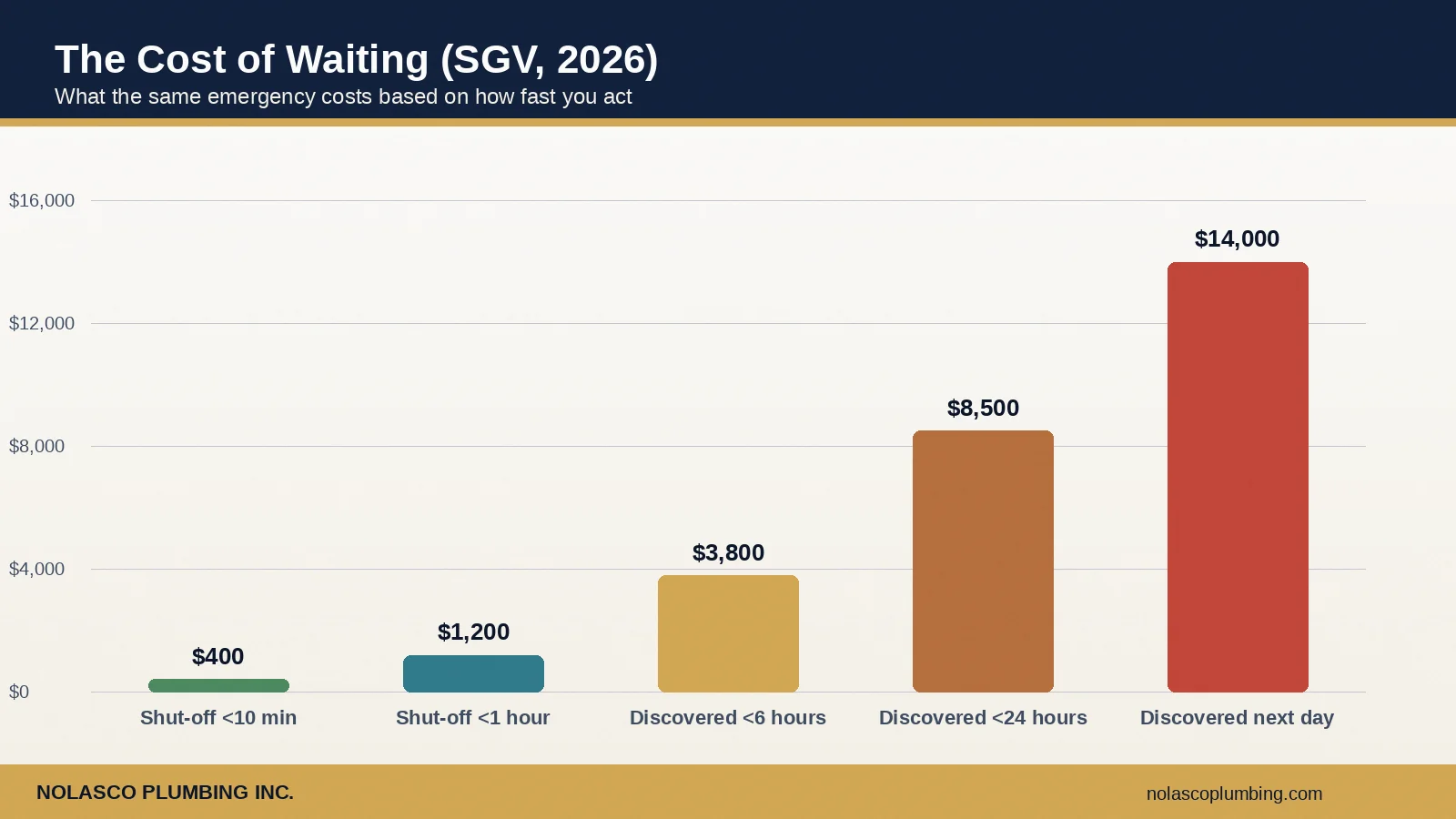
| Response Time | Typical Total Cost | What’s Damaged |
|---|---|---|
| <10 min (shut-off + call) | $300–$500 | Localized wet floor, no drying needed |
| <1 hour | $800–$1,500 | Sub-floor damp, minor drywall |
| <6 hours | $3,000–$5,000 | Drywall replace, subfloor drying |
| <24 hours | $6,000–$10,000 | Flooring replace, mold prevention |
| Next day+ | $12,000–$18,000 | Cabinets, flooring, mold remediation |
Prevention: 6 things to do before an emergency ever happens
1. Walk your house and locate every shut-off valve. Do it this weekend. Bring a sharpie or a tag; label each one so anyone in the family can find it.
5. Test your main valve once a year. Close it, open a faucet to confirm no flow, then reopen it. This prevents the stuck-valve emergency-inside-an-emergency scenario.
6. Schedule a preventive plumbing checkup. Our EagleCare Pro membership catches most emergencies before they happen, one inspection a year, priority scheduling, and 15% off any service.
Water running RIGHT NOW? Call, don't type.
Nolasco is available 24/7 across the entire San Gabriel Valley. We answer live, we give you real-time triage over the phone, and we’re on the way within an hour to most SGV cities.
Frequently Asked Questions
Where is the main water shut-off valve in my house?
In most SGV homes it’s in one of four places: on an exterior wall where the water line enters the home, in the garage along the shared wall, in a utility closet, or (if you can’t find any) at the street meter shut-off in the sidewalk box. Walk your house this weekend and find yours before you need it.
How much does an emergency plumber cost in the SGV?
Emergency plumbing service calls in the SGV run $150–$350 for the trip charge plus diagnostic. Actual repair costs depend on the issue, but the far bigger cost variable is water damage, not the plumbing fix. A leak caught in under 10 minutes typically stays under $500 total. A leak discovered the next day averages $14,000.
What is a plumbing emergency (worth calling at 2am)?
Anything with active or uncontrolled water: burst pipe, water heater rupture, active slab leak, sewage backup into the home, or any leak you can’t shut off with a local valve. Also gas leaks and no-hot-water in winter for households with medical needs. Slow drains and dripping faucets can wait until morning.
What's the first thing to do in a plumbing emergency?
Shut off the water. Close the closest valve if you can identify the source, or close the main house valve if you can’t. Every valve turns clockwise to close. Then photograph everything before moving items, then call a 24/7 licensed plumber.
Should I use a plunger on an overflowing toilet?
Not until you shut off the water. Close the shut-off valve behind the toilet tank (turn clockwise), wait 2–3 minutes for the bowl level to drop, then plunge. Plunging a full bowl just splashes contaminated water everywhere.
Does homeowners insurance cover plumbing emergencies?
California policies typically cover sudden/accidental water damage (burst pipe, water heater rupture) but not gradual leaks (slab leak that went undetected for months). Photograph everything before cleanup and file the claim before repairs start. Get an itemized invoice from your licensed plumber.