
Tankless vs. Heat Pump Water Heater in the SGV, 2026 Cost + Rebate Guide
Which water heater actually makes sense for a Pasadena Craftsman, an Arcadia ranch, or a newer Baldwin Park build in 2026? Here’s the honest, plain-English breakdown, with real installed costs and every rebate you can stack.
If you don't read another word
- Tankless (gas) is best for busy families who already have gas service and want endless hot water for the next 20+ years. Installed: $4,800–$6,500 in the SGV.
- Heat pump (electric) is best if you have a garage, want the biggest rebates, and are okay with a bigger footprint. Installed: $5,500–$8,000, but rebates can drop the effective cost to ~$1,500–$2,500.
- 2026 stackable rebates for heat pump: TECH Clean California + HEEHRA + Federal 25C + SCE = up to $5,000+ in combined savings.
- The SGV climate favors heat pumps, mild year-round temps in Pasadena, Arcadia, Alhambra, and Whittier let them run at peak efficiency almost every day.
What's actually the difference?
A tankless water heater burns natural gas on demand to heat water instantly as it flows through the unit, no storage tank. A heat pump water heater uses electricity to move heat from the surrounding air into a storage tank (like a reverse air conditioner). Tankless is fast and endless; heat pump is dramatically more efficient and eligible for major rebates in California.
Both are legitimate upgrades over the standard 40- or 50-gallon tank in most San Gabriel Valley homes. Both will save you money over time. But they solve different problems, and in 2026, the rebate math has changed enough that a lot of SGV homeowners who assumed tankless was the obvious choice are switching to heat pump at the last minute.
Let’s break it down.
Real installed costs in the San Gabriel Valley (2026)
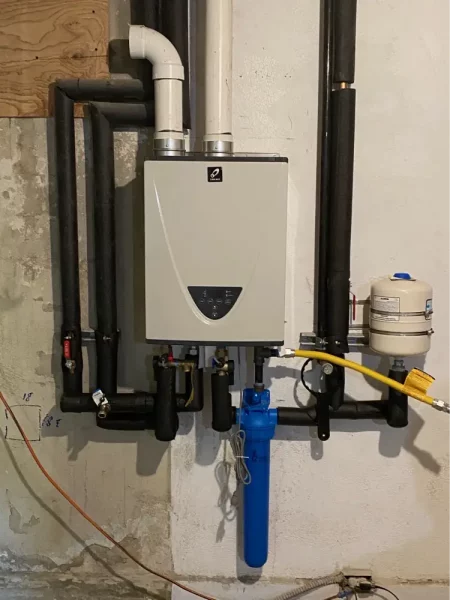
In 2026, a fully installed gas tankless water heater in the SGV runs $4,800–$6,500. A fully installed heat pump water heater runs $5,500–$8,000, but after stacking California rebates, the effective out-of-pocket cost for most homeowners is $1,500–$2,500.
Prices vary a lot depending on your home. A tankless install goes up if your existing gas line needs to be upsized from 1/2″ to 3/4″ (extremely common in older Alhambra, San Gabriel, and Pasadena homes), if venting has to be re-routed through a wall, or if a condensate drain needs to be added. A heat pump install goes up if your electrical panel is under 100A and needs an upgrade, which is a real issue in pre-1990 Craftsman and Spanish revival homes across the SGV.
| Water Heater Type | Unit Cost | Installation | All-in Installed (SGV) |
|---|---|---|---|
| Standard tankGas, 40–50 gal | $700–$1,400 | $800–$1,400 | $1,800–$2,800 |
| TanklessGas, whole-home | $1,800–$3,200 | $2,500–$3,500 | $4,800–$6,500 |
| Heat pumpElectric, 50–80 gal | $1,900–$3,800 | $2,800–$4,200 | $5,500–$8,000 |
| Heat pump AFTER rebatesTypical SGV homeowner | , | , | $1,500–$2,500 |
The 2026 rebate stack, this is the part most homeowners miss
California heat pump water heater rebates stack in 2026. That means you can combine the state TECH Clean California rebate, the federal HEEHRA point-of-sale rebate (if income-qualified), the federal 25C tax credit, and the SCE electrification rebate, for total savings that routinely exceed $5,000 on a single install.
Here’s how the four main programs work:
1. TECH Clean California ($1,500–$4,885)
Applied as an instant rebate through participating contractors (like Nolasco) at the time of install, no paperwork for you. The amount depends on your utility, home type, and income tier. Most SGV homes serviced by SCE + SoCalGas qualify for the $1,500–$3,000 range; income-qualified households get up to $4,885.
2. HEEHRA (Federal IRA rebate, up to $1,750)
Point-of-sale rebate for households under 150% of the local Area Median Income. In LA County, that’s roughly $145,000 for a family of four (2026 threshold). Under 80% AMI gets the full $1,750; between 80% and 150% AMI gets 50%.
3. Federal 25C Tax Credit (30%, up to $2,000)
Claimed on IRS Form 5695 when you file your taxes. Applies to the total installed cost (equipment + labor). Non-refundable, but rolls over to future years.
4. Southern California Edison Rebate ($300–$1,000)
SCE offers a separate electrification incentive for switching from gas to electric water heating. Usually filed post-install; check the SCE Marketplace before booking.
$300–$500 rebate
SoCalGas offers a $300–$500 rebate for high-efficiency gas tankless installs (typically 0.90+ Uniform Energy Factor). Not as generous as the heat pump stack, but worth grabbing if you’re going that direction.
When tankless makes more sense
Best for you if…
You have 3+ people in the house, an existing gas line, and you value endless hot water and a 20+ year lifespan over rebate maximization. Tankless is also the right call if your utility room is tiny, they mount on the wall and free up floor space.
Tankless shines in bigger SGV homes where multiple showers, a dishwasher, and a washing machine can run at the same time without running the water cold. If you have teenagers, a tankless is often worth the extra installed cost purely for the household peace it buys you.
It also shines if your home is in a neighborhood with reliable natural gas service (essentially all of the SGV) and you’re not planning to electrify the rest of the home anytime soon. Note: California building code has been steadily tightening on new gas installs, if you’re doing a major remodel that requires permits, ask your contractor how the 2025 Title 24 updates apply to your project.
When heat pump makes more sense
Best for you if…
You have a garage or utility room with 100+ sq ft, care about your carbon footprint, and want to maximize the 2026 rebate stack. Heat pump is also the right call if you’re already on a solar system, you’re essentially getting free hot water once the sun is up.
The San Gabriel Valley’s Mediterranean climate is nearly perfect for heat pump water heaters. They lose efficiency below 40°F ambient, a temperature we hit maybe 10 nights a year in Pasadena or Arcadia. Meanwhile, they operate at their COP peak (~4.0) in the 60–90°F range that dominates our garages 10 months out of 12.
The one thing to be honest about: heat pump water heaters currently last 10–15 years versus 18–22 for a well-maintained tankless. The technology is improving fast, but a longer warranty is worth paying attention to when you compare units.
What SGV homes get wrong when they install either one
After 17+ years of installing water heaters across Pasadena, Arcadia, Alhambra, Whittier, Baldwin Park, and every city in between, here are the four mistakes we see most often:
1. Skipping the gas-line upgrade on tankless installs
A whole-home tankless needs a 3/4″ gas supply line. About 70% of pre-1990 SGV homes have 1/2″ lines running to the water heater location. If your installer doesn’t upsize the line, you’ll get lukewarm showers when the furnace kicks on. This is the #1 reason homeowners are unhappy with tankless.
2. Putting a heat pump in a tiny closet
Heat pumps need 700+ cubic feet of unconditioned airspace, roughly a 10×10 room with an 8-foot ceiling. Interior closets need ducting kits ($400–$800 extra) and still don’t run as efficiently. If you don’t have a garage, laundry room, or basement, tankless is probably your answer.
3. Ignoring hard-water descaling
4. Not permitting the work
Water heater replacements require a plumbing permit in every SGV city. Uninsured, unpermitted work is the fastest way to void your homeowners insurance if something goes wrong, and it will slow down a home sale later. A licensed plumber pulls the permit as part of the job.
Our honest recommendation for most SGV homes in 2026
If you have a garage, install the heat pump water heater. The 2026 rebate stack makes the effective installed cost lower than tankless, the SGV climate is ideal for it, and it decarbonizes your home. If you don’t have a garage or you have 4+ people relying on hot water simultaneously, install a gas tankless. Both are dramatically better than a standard tank, and any standard tank over 10 years old in the SGV is running on borrowed time.
Not sure which one fits your home?
We’ll come out, walk through your utility space, check your panel and gas line, and give you an upfront quote for both options, with every 2026 rebate you qualify for pre-calculated. Free, no pressure.
Frequently Asked Questions
Is a heat pump water heater worth it in the San Gabriel Valley?
For most SGV homes with a garage or well-ventilated utility space, yes. The SGV’s mild climate is ideal (heat pumps work best above 40°F ambient), and stackable 2026 rebates from TECH Clean California, HEEHRA, and the federal 25C tax credit can bring the effective installed cost to $1,500–$2,500, often less than a tankless gas replacement.
How much does a tankless water heater cost to install in Pasadena or Arcadia?
In 2026, a licensed installed price for a whole-home gas tankless in the SGV typically runs $4,800–$6,500. Costs go up if your gas line needs to be upsized to 3/4″, if venting has to be re-routed, or if the panel requires a 120V outlet added near the unit.
What rebates are available for heat pump water heaters in California in 2026?
SGV homeowners can stack four programs: TECH Clean California ($1,500–$4,885), HEEHRA point-of-sale rebates up to $1,750 (income-qualified), the federal 25C tax credit (30% of installed cost, up to $2,000), and SCE electrification rebates ($300–$1,000). Total stacked savings frequently exceed $5,000.
Can I put a heat pump water heater inside my house?
Technically yes, but it’s usually not ideal. Heat pump water heaters cool and dehumidify the room they’re in and need at least 700 cubic feet of unconditioned airspace to operate efficiently. In SGV homes, the garage is almost always the best location. Interior closets require ducting kits and can sound like a mini-fridge running 8–12 hours a day.
How long do tankless and heat pump water heaters last?
A properly maintained gas tankless unit typically lasts 18–22 years, nearly double a standard tank. Heat pump water heaters currently average 10–15 years. In hard-water areas of the SGV (most of it), annual descaling is critical for tankless longevity, and heat pump anode rods should be checked every 3 years.
Do I need to upgrade my electrical panel for a heat pump water heater?
Most heat pump water heaters require a dedicated 240V / 30A circuit. Newer SGV homes (post-1990) usually have panel capacity to spare. Older Craftsman-era homes in Pasadena, Alhambra, and San Gabriel with 100A panels often need either a panel upgrade or a 120V/plug-in heat pump model (which run slower but avoid the electrical work).
Service Areas Across the San Gabriel Valley
Altadena · Arcadia · Azusa · Baldwin Park · Covina · Duarte · El Monte · Glendora · Hacienda Heights · Irwindale · La Cañada Flintridge · La Puente · La Verne · Monrovia · Monterey Park · Pasadena · Pomona · Rosemead · Rowland Heights · San Dimas · San Gabriel · San Marino · Sierra Madre · South El Monte · South Pasadena · Temple City · Walnut · West Covina.